


Home / News / Industry news
Share
A tapered roller bearing is often described by two part numbers: one for the cone and one for the cup. That looks simple until a maintenance team has a loose ring, an old package and an equipment list that do not agree with one another. Ordering from the bore and outside diameter alone can produce a component that fits one dimension but does not belong to the required bearing assembly.
The safer approach is to identify every component separately and then verify the approved combination in the manufacturer's current catalogue. This guide explains what purchasing and maintenance teams should check, using TIMKEN 39243DE and 39433 as a practical example.
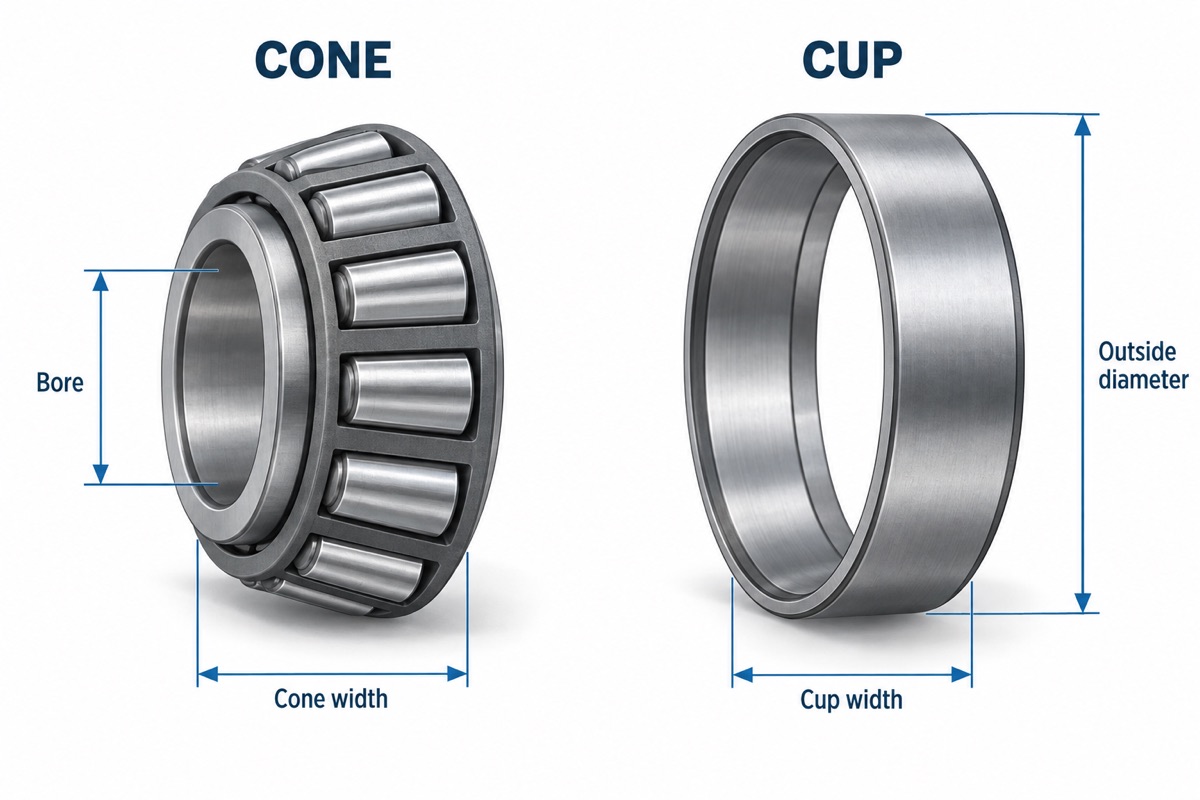
In a tapered roller bearing, the cone assembly includes the inner ring, rollers and cage. The cup is the outer ring. These parts are separable, which is useful during installation and service, but it also creates a purchasing risk: a cone and a cup that look similar are not automatically a matched set.
The basic dimensions have different meanings. The cone is normally identified by its bore and cone width. The cup is identified by its outside diameter and cup width. A complete assembly may also have an overall width and internal geometry that cannot be confirmed by adding or comparing the visible ring dimensions.
When a bearing is removed from equipment, keep the cone, cup, spacers and package labels together. Mixing components from different positions can make later identification much harder.
Many inch-series tapered roller bearings use one number for the cone and another for the cup. A purchase order that contains only one of those numbers may be requesting a component rather than a complete bearing.
This distinction affects price, quantity and receiving inspection. If the buyer needs ten complete bearings, the supplier must know whether the request means ten cone assemblies and ten cups, or ten pieces of only one ring. For double-row arrangements, the component count and spacer arrangement may be more complex.
Write the required unit clearly in the RFQ. Useful terms include cone assembly only, cup only, one complete set and complete double-row assembly. If the required arrangement is uncertain, send photographs rather than guessing.
No. Boundary dimensions are an important check, but they do not prove compatibility. Bearings can differ in contact geometry, internal clearances, effective spread, spacer arrangement and design features even when some dimensions are close.
A reliable verification should answer four questions:
Does the current manufacturer catalogue list the cone and cup on the same assembly line?
Does the equipment parts list specify the same complete combination?
Do the markings on all rings agree with the package label?
Are any spacers, flanges or special features part of the original arrangement?
Cross-brand comparison needs the same discipline. A cross-reference is a starting point for technical review, not automatic proof that two products are identical.
TIMKEN lists 39243DE as a double-row cone with an extended small rib in its 39000–39500 Series dimension catalogue. The listed component data are:
| Item | TIMKEN 39243DE |
|---|---|
| Component type | Double-row cone |
| Bore diameter | 61.912 mm |
| Cone width | 101.600 mm |
| Minimum radius | 0.8 mm |
| Approximate mass | 1.84 kg |
These figures identify the cone component. They do not, by themselves, identify its mating cup or prove a complete assembly number.
TIMKEN lists 39433 as a single cup. Its component data are:
| Item | TIMKEN 39433 |
|---|---|
| Component type | Single cup |
| Outside diameter | 110.058 mm |
| Cup width | 17.236 mm |
| Minimum radius | 2.3 mm |
| Approximate mass | 0.31 kg |
In the reviewed TIMKEN table, 39433 appears with 39236DE. The same table lists 39243DE separately and does not show 39433 on the 39243DE line. Therefore, the two numbers should not be described as a confirmed standard assembly without additional evidence from the bearing markings, packaging or equipment documentation.
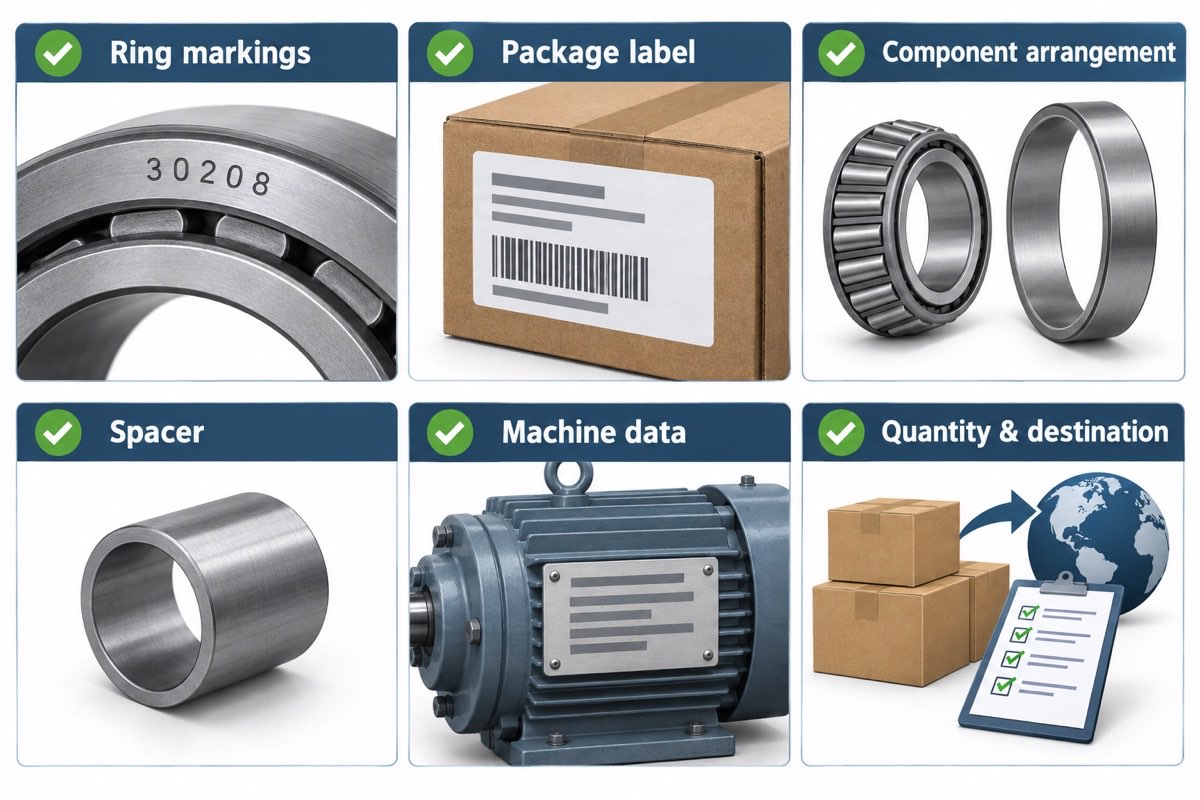
Start with the physical evidence. Clean only the marked surfaces carefully enough to read them; do not polish away faint characters. Photograph the full marking on each ring, not just the clearest number. Include a wider image that shows how many cones, cups and spacers are present.
Then collect the following information:
Complete markings from every ring and spacer
Original manufacturer and package label
Machine maker, model and bearing position
Shaft and housing dimensions, if available
Required quantity stated as components or complete sets
Destination country and requested delivery date
Whether an original brand, an alternative or both should be quoted
For an urgent breakdown, state which information has been verified and which is still uncertain. A technically honest quotation is more useful than a fast quotation based on an assumed pair.
The purchase order should repeat the complete component designations and define the unit being purchased. For example:
Please quote TIMKEN 39243DE cone assembly only, quantity __ pieces. The mating cup is not yet confirmed. Please verify the marking photographs before quotation.
Or, when the complete arrangement has been confirmed:
Please quote the verified cone, cup and spacer arrangement shown on the attached equipment drawing, quantity __ complete sets. Confirm every supplied component number in the quotation.
This wording reduces ambiguity and gives the receiving team a clear inspection standard.
Replacement practice should follow the equipment and bearing manufacturer's instructions. Wear patterns develop between working components, and visible appearance alone is not enough to establish suitability. When in doubt, replace and inspect the arrangement as the specified set.
No. TIMKEN identifies 39433 as a single cup. The mating cone must be established separately from approved catalogue or equipment data.
Not in the TIMKEN catalogue table reviewed for this article. The table provides separate data for both numbers but does not list them together as a standard assembly. Additional identification evidence is required.
Send sharp photographs of every ring marking, all package labels, the complete component arrangement and any spacers. An equipment nameplate or parts-list page is also useful when available.
Correct tapered roller bearing identification starts with the component numbers, not an assumed assembly. Check the cone, cup and any spacers separately, then confirm the combination against current manufacturer and equipment data. The TIMKEN 39243DE and 39433 example shows why two genuine part numbers should not automatically be treated as one verified set.
FONKIN BEARING can review marking photographs, bearing lists and equipment information before preparing a quotation. New customers may send the required quantity, destination and images by WhatsApp at +86-187-5155-1686 or email fonkin-industries@188.com.
+86-137-7105-7666
+86-510-6831-3099