English
 Spanish
 Arabic

Home / News / Industry news
Share
Cement production exposes bearings to heavy loads, dust, vibration, misalignment and changing temperatures. Crushers, conveyors, bucket elevators, fans and grinding equipment can all experience premature bearing failure when selection or lubrication does not match the operating environment. Based on the bearing lists reviewed by FONKIN Bearing, incomplete suffixes and missing operating data are two common reasons buyers receive an unsuitable quotation.
Spherical roller bearings are widely used in these machines because their two rows of rollers provide high radial capacity and support axial load in both directions. Their self-aligning design can also accommodate moderate shaft deflection or housing misalignment. These advantages do not remove the need for correct clearance, sealing, mounting and maintenance.
The starting point is the machine, not the bearing number. Record shaft speed, radial and axial load, shock load, operating temperature, shaft orientation, duty cycle and surrounding contamination. A conveyor pulley and a crusher may use bearings of similar dimensions but require very different internal designs and service factors.
For replacement orders, inspect the full bearing designation and suffixes. The suffix may identify internal clearance, cage, lubrication holes, seals or other features. An apparently similar bearing without the correct suffix may not perform the same way.
Open spherical roller bearings are common in protected housings. Sealed designs may improve contamination control in selected applications, but allowable speed, relubrication practice and operating temperature must be checked. Bearings with lubrication grooves and holes in the outer ring can support effective relubrication when the housing arrangement is designed accordingly.
Split plummer block housings are frequently used for conveyors and fans because they simplify installation and inspection. The complete system includes the bearing, housing, seals, adapter or withdrawal sleeve, locating rings, lubricant and shaft fit. Each component must be compatible.
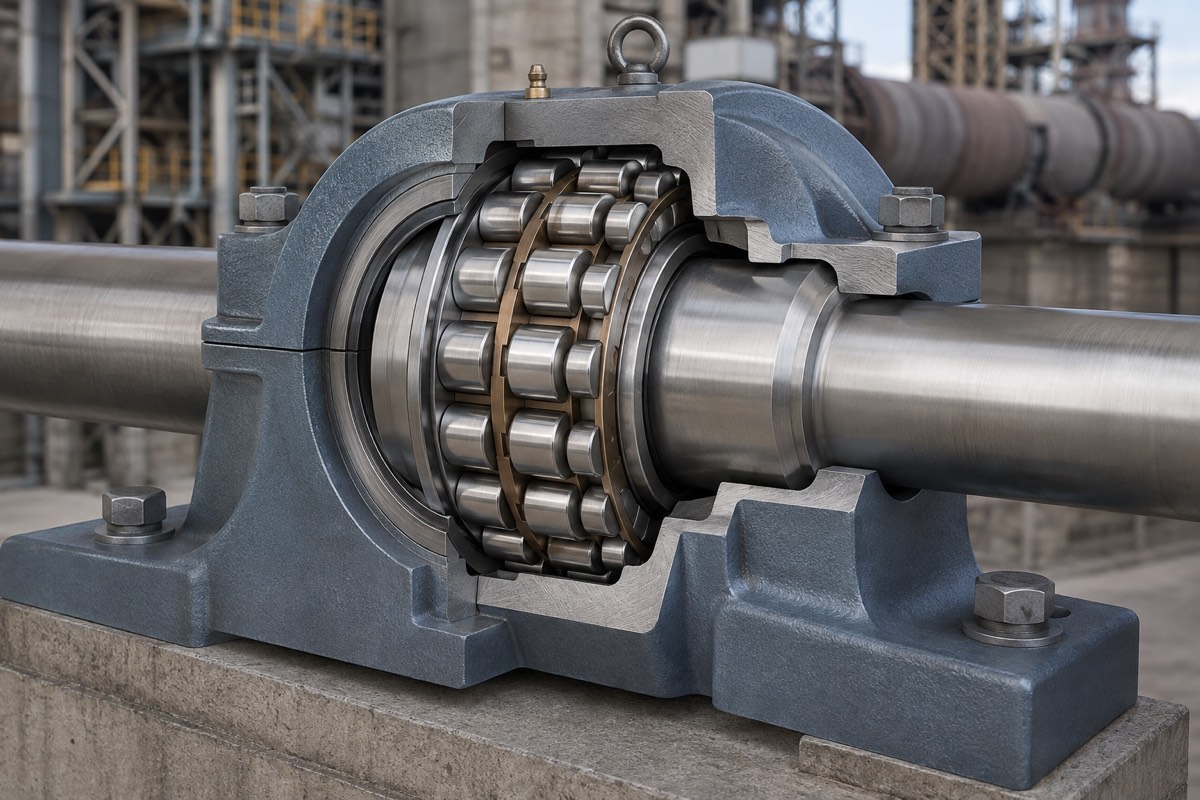
Internal clearance changes after mounting and during operation. An interference fit on the shaft can reduce radial clearance. Temperature differences between the inner and outer rings can reduce it further. For this reason, C3 clearance is often considered for heavy-duty or elevated-temperature applications, but C3 is not automatically correct for every cement plant machine.
Too little operating clearance may lead to high temperature and early failure. Excessive clearance can reduce load distribution quality and increase vibration. Selection should consider shaft fit, housing fit, temperature gradient, load and speed. Where an adapter sleeve is used, mounting drive-up or clearance reduction must be measured according to the applicable instructions.
Cement dust is highly damaging when it enters the bearing or lubricant. Effective sealing therefore has a direct influence on service life. Seal selection may include labyrinth arrangements, contact seals, V-rings or combinations, depending on speed, contamination and shaft condition.
Inspect shaft sealing surfaces for wear and verify that drain paths do not allow contaminants to accumulate. During maintenance, keep replacement bearings and tools away from open dust sources. Do not remove packaging until the installation area is ready.
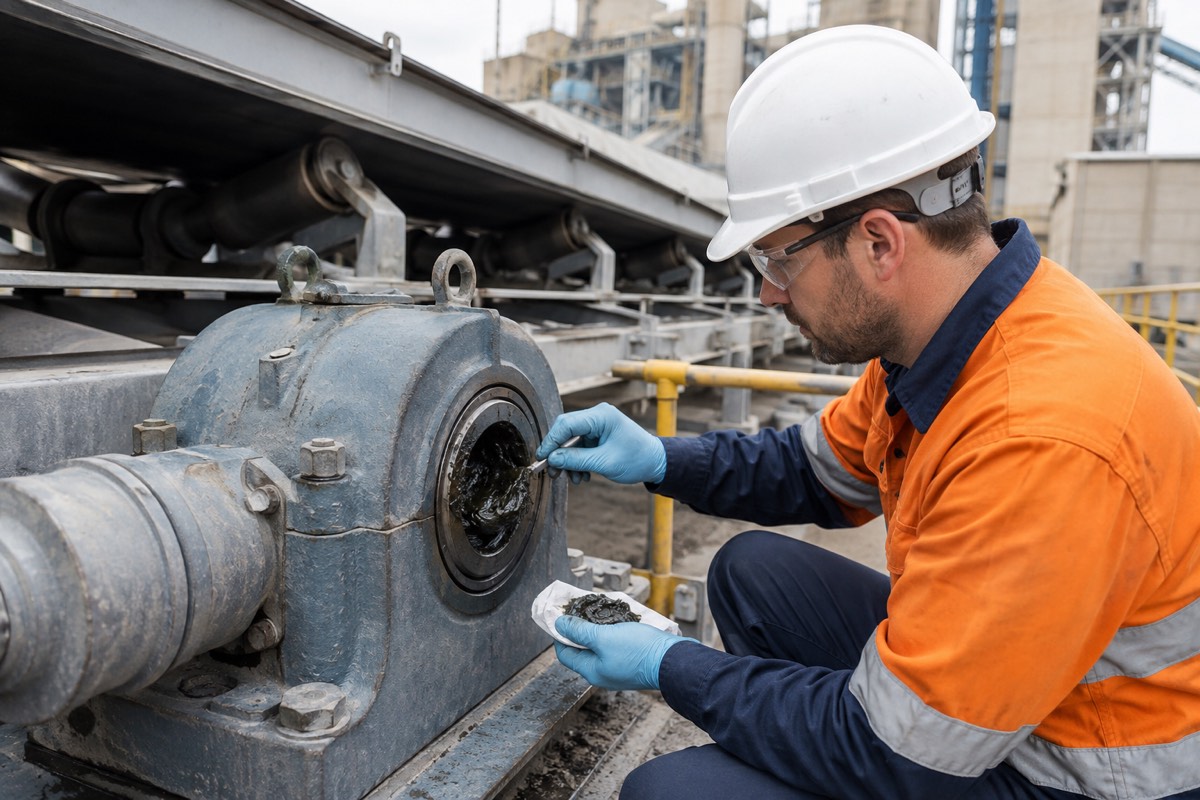
The lubricant must suit bearing size, speed, load, temperature and contamination level. Grease consistency, base oil viscosity and thickener compatibility should be checked before changing products. Mixing incompatible greases can affect consistency and lubrication performance.
More grease is not always better. Overfilling can cause churning and heat, while insufficient grease leaves rolling contacts inadequately protected. Establish relubrication intervals using operating data and then adjust them based on temperature, vibration, grease condition and contamination observations.
Automatic lubricators can improve consistency on difficult-to-access equipment, but delivery lines must be inspected for blockage or damage.
Improper mounting can damage raceways before the machine starts. Apply force only to the ring being fitted and use suitable mechanical, hydraulic or controlled heating methods. Direct hammer blows can create impact damage and should be avoided.
For tapered-bore bearings, control the mounting position by measuring clearance reduction or axial drive-up. Confirm the housing is clean, correctly aligned and securely supported. After mounting, rotate the shaft where possible and establish baseline temperature and vibration readings.
Trend data is more useful than a single measurement. Record bearing temperature, vibration, noise, lubricant condition and leakage at consistent operating conditions. A rising trend may indicate lubrication problems, looseness, misalignment, contamination or developing bearing damage.
When a bearing fails, examine the raceways, rollers, cage, lubricant and seals before disposal. Failure evidence can help determine whether the main cause was fatigue, contamination, inadequate lubrication, electrical damage, overload or incorrect mounting.
Send the following information to improve quotation accuracy:
Complete bearing and housing designations
Machine type and installation position
Shaft speed and operating temperature
Required quantity
Preferred clearance and cage, if specified
Seal and lubrication requirements
Photographs of existing markings
Destination country and required delivery date
Original brand, equivalent option or both
FONKIN Bearing can review bearing and housing lists for conveyors, fans, crushers and other industrial machinery. When equivalent options are requested, the comparison should cover dimensions, internal design, dynamic and static load ratings, speed limits, internal clearance, cage, seals and application conditions—not only the basic bearing number.
Reliable cement plant bearing operation depends on selecting and maintaining the entire bearing system. Load, clearance, fit, sealing, lubricant and mounting practice must work together. A technically complete RFQ helps suppliers recommend a closer match and reduces the risk of unplanned downtime.
Send your bearing list, equipment model or photos of the existing markings to FONKIN Bearing for specification comparison and quotation support. Please include the destination country, quantity and required delivery date so our team can prepare a more accurate response.

+86-137-7105-7666
+86-510-6831-3099