English
 Spanish
 Arabic

Home / News / Industry news
Share
When a gearbox, motor or pump starts leaking, the purchasing request often arrives as one line: “We need an oil seal in this size.” That is enough to begin a search, but not enough to select a dependable replacement.
Two rotary oil seals can share the same shaft diameter, housing diameter and width while using different lip materials, spring arrangements and outside-diameter designs. One may work well in a grease-lubricated bearing housing; the other may be intended for a different temperature, speed or fluid. Both will fit. Only one may suit the job.
For buyers, the practical rule is simple: confirm the size, then describe the application. A supplier should know what the seal retains, what it keeps out and how the shaft operates before recommending an alternative.
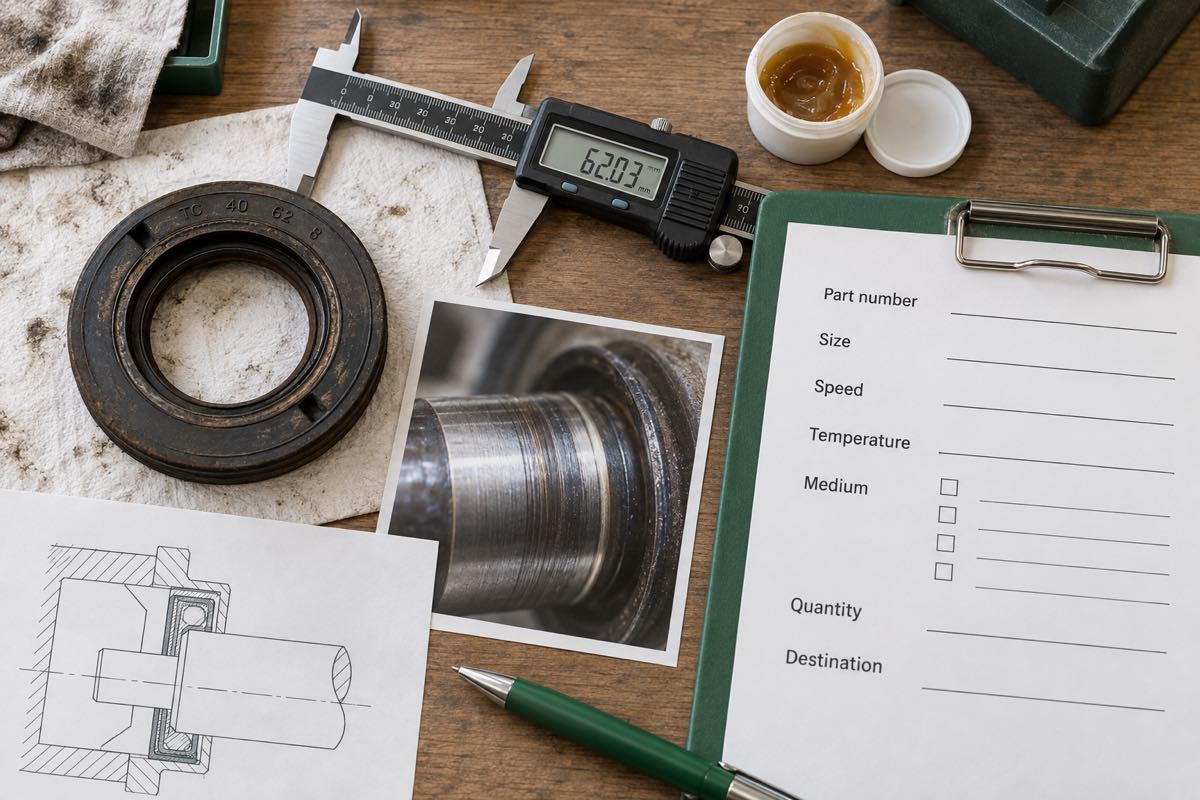
At minimum, provide:
shaft diameter, housing bore and seal width;
equipment type and installation position;
shaft speed;
working and peak temperature;
lubricant or process fluid;
pressure difference across the seal;
dust, water or washdown exposure;
old seal marking, photographs and required quantity.
For an exact branded replacement, send the full part number including every suffix. For an unidentified or obsolete seal, add shaft and housing measurements plus the operating data above.
Most metric rotary shaft seals are described by three dimensions:
d — shaft diameter
D — housing bore diameter
b — seal width
If the original part number is readable, do not shorten it. A suffix may identify a different compound, lip arrangement or construction. When the marking is damaged, measure the shaft and housing whenever possible rather than estimating from the old seal alone. Also record the available installation space and the direction from which the seal will be fitted.
If the old seal is still available, photograph both faces, the lip, the spring and every moulded code. A clear photo beside a ruler can help identify the construction, but it does not replace accurate measurements.
A rotary oil seal may have one or more jobs:
retain oil or grease inside a bearing housing or gearbox;
exclude dust, water, metal particles or process contamination;
separate two different media;
work during intermittent or continuous shaft rotation.
The main sealing lip normally faces the fluid or lubricant being retained. Where dust or splash water is a concern, an auxiliary exclusion lip may be appropriate. But a second lip is not a free upgrade: added contact also means added friction and heat. This is why the equipment environment belongs in every serious enquiry.
When two quotations use the same dimensions but different materials or constructions, they are not necessarily equivalent. Use the following table to make the comparison visible.
| Information required | What to provide | Why it matters |
|---|---|---|
| Seal size | Shaft × housing bore × width | Confirms physical fit |
| Shaft speed | rpm and, if known, surface speed | Affects lip temperature and wear |
| Temperature | Normal continuous, start-up and peak | Helps screen the lip material |
| Medium | Oil, grease, water or process fluid; include grade and additives | Material compatibility varies |
| Pressure | Normal differential and possible pressure spikes | Standard lip seals may not suit pressurised duty |
| Duty cycle | Continuous, intermittent or reversing | Changes heat and lubrication conditions |
| Shaft condition | Material, hardness, surface finish and wear groove | Directly affects lip life and leakage |
| Runout or misalignment | Measured value if available | Excess motion can prevent stable lip contact |
| Environment | Dust, slurry, washdown, humidity or outdoor exposure | Determines exclusion requirements |
| Orientation | Horizontal or vertical shaft | Can affect lubrication at the lip |
Seal speed cannot be judged from rpm alone. A larger shaft has a higher surface speed at the same rpm, and lip material, lubrication, pressure, counterface condition and heat dissipation also matter. For critical equipment, ask the supplier to identify the offered manufacturer and verify the selection against that manufacturer’s current technical data.
Nitrile rubber is widely used with industrial oils and greases. It is often the first material to check for ordinary operating conditions and cost-sensitive replacement work. The exact compound and lubricant additives still need to be compatible.
Fluoroelastomer is often considered where temperature or fluid resistance exceeds the capability of the proposed NBR compound. It is not “better” in every application. The buyer should ask why FKM is being offered and whether its actual compound is suitable for the stated fluid and temperature range.
PTFE sealing elements are used in selected high-speed, low-friction, chemical or limited-lubrication duties. Their lip geometry and installation method may differ considerably from a conventional spring-loaded elastomer seal. Treat PTFE as a design choice, not a simple material substitution.
Published temperature charts are useful for screening, but they are not a purchase guarantee. Compound formulation, fluid, speed, pressure and test method all affect the result. Ask for the specification of the actual seal being quoted.
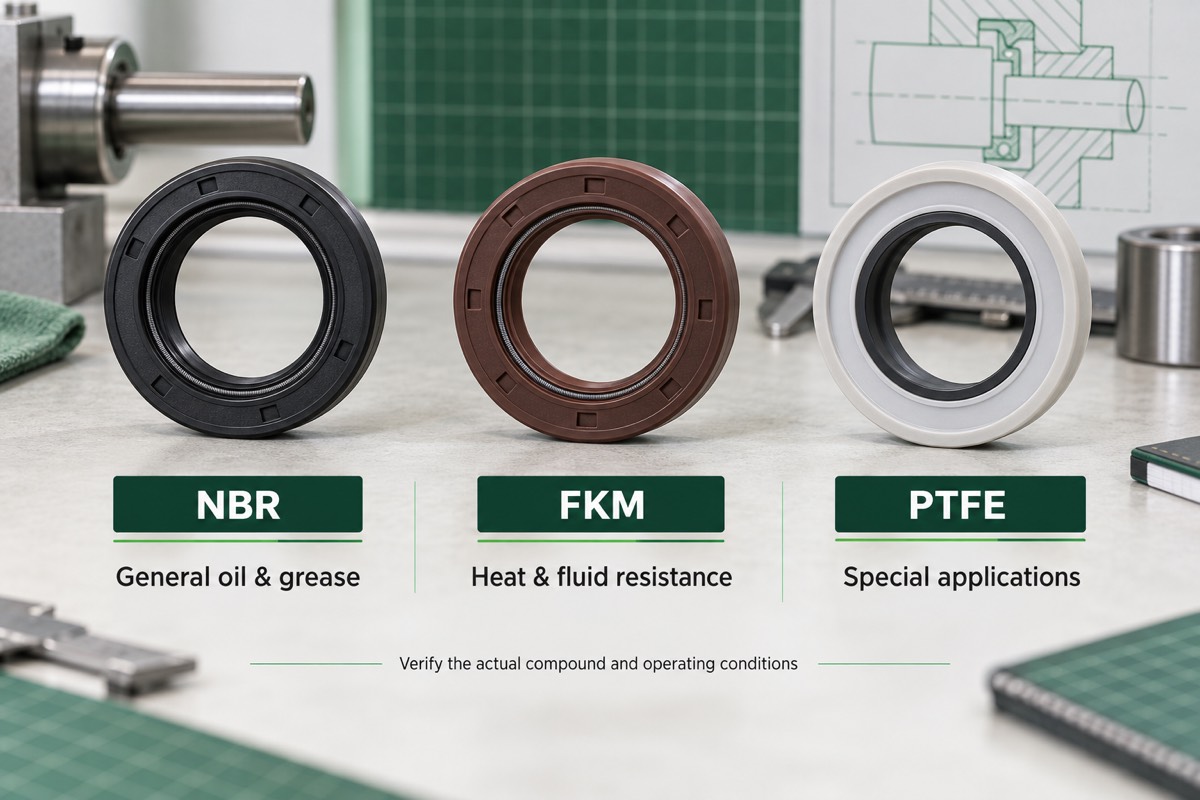
Common options include a spring-loaded primary lip, a primary lip with an auxiliary dust lip, and different rubber-covered or metal outside diameters. The appropriate choice depends on the housing, contamination, thermal expansion and installation conditions.
Before accepting an alternative, compare the lip material and design, spring presence and material, outside-diameter construction, sealing direction, dust-lip arrangement, and every manufacturer suffix or drawing note.
A photograph can confirm the general shape, but it cannot prove equivalent performance. For a brand-to-brand alternative, request a drawing or a written comparison of the critical construction details. If the supplier cannot identify the material or lip arrangement, the quotation is incomplete.
The shaft is one half of the sealing system. Its hardness, roundness, runout, lead pattern and surface finish can be as important as the seal itself.
A surface that is too rough can abrade the lip and create leakage paths. A surface that is too smooth may also reduce effective lubrication at the contact area. Spiral machining lead can pump fluid under the lip even when the measured roughness appears acceptable.
Inspect the exact track where the old lip ran. If there is a visible groove, corrosion, burr or coating damage, fitting another seal at the same position may reproduce the leak. Depending on the equipment, the remedy may involve restoring the shaft, using an approved repair sleeve or repositioning the lip. The equipment requirements should decide the repair—not convenience alone.
| Observed condition | Items to check before reordering |
|---|---|
| Polished or worn lip track | Shaft roughness, contamination, lubrication and runout |
| Hard or cracked lip | Actual temperature, fluid compatibility and storage age |
| Lip rolled or reversed | Installation tool, shaft chamfer and pressure direction |
| Leakage around outside diameter | Housing bore damage, seal OD design and installation alignment |
| Shaft groove | Counterface hardness, contamination and operating time |
| Leakage soon after start-up | Orientation, assembly damage, dry start, pressure or wrong construction |
One photograph rarely proves the root cause. Record where the leakage appeared, how long the seal operated and whether the lubricant, speed, temperature, pressure or cleaning process changed before the failure. This small amount of history can prevent the buyer from purchasing the same problem twice.
Clean the housing, shaft and surrounding area.
Remove burrs and confirm a suitable lead-in chamfer.
Protect the lip from splines, keyways and sharp shaft edges.
Confirm the sealing lip faces the correct direction.
Apply only the lubricant recommended for the seal and application.
Use an installation tool that presses the seal squarely and supports the correct face.
Do not strike the seal directly with a hammer.
Check that the installed seal is level and at the intended depth.
If the equipment maker provides an assembly procedure, follow it. Installation guidance for one seal construction may not apply to another.
Oil seal enquiry
Existing marking or part number:
Size (shaft × housing bore × width):
Equipment or application:
Shaft speed (rpm):
Continuous and maximum temperature:
Fluid or lubricant and grade:
Pressure differential or pressure spikes:
Contamination or washdown conditions:
Shaft material and surface condition:
Required quantity:
Destination country:
Photos or drawing attached: Yes / No
For an unidentified seal, include clear photographs of both faces, the moulded markings, the shaft contact area and the installation position. When an exact original part number is available, provide it without shortening the suffix. This normally saves more time than a long email exchange based only on dimensions.
Not automatically. The size may fit while the lip material, construction, pressure capability, sealing direction or outside diameter differs. Compare the full specification before treating it as interchangeable.
No. FKM may suit certain higher-temperature or fluid conditions, while NBR can be the more appropriate and economical material for many general applications. Compatibility must be checked for the actual medium and operating range.
Not automatically. An auxiliary lip can improve contamination exclusion, but it also adds friction. Its suitability depends on lubrication, speed, temperature and the environment.
Many conventional elastomer lip seals rely on a very small lubricating film at the contact area. Dry-running suitability should never be assumed; it must be confirmed for the specific design and duty.
Reusing a removed rotary shaft seal is generally a poor maintenance choice because the lip may be worn or damaged during removal. Follow the equipment and seal manufacturer’s instructions.
Send FONKIN BEARING the original part number or measured size, equipment type, operating conditions, quantity and destination country. If the old seal cannot be identified, add photographs of the seal and shaft contact area. We can then compare available constructions with the information supplied instead of sending a size-only quotation.
WhatsApp: +86-187-5155-1686
Email: fonkin-industries@188.com
Contact: Send an enquiry
FONKIN BEARING is an independent industrial product supplier. Brand names, where mentioned, identify reference products or technical sources and do not imply affiliation. Final application suitability should be checked against the offered manufacturer’s current technical data and, where necessary, validated in the equipment.
SKF, Radial Shaft Seals
SKF, CR Seals Handbook
Parker, Rotary Seal Design Guide
Trelleborg, Rotary Seals Catalogue

+86-137-7105-7666
+86-510-6831-3099